


A change in your skin or hair deserves more than a quick beauty fix. When exploring health & beauty, understand glutathione’s connection to skin health and treat hair loss as a sign to pay attention to, not a diagnosis on its own.
It’s natural to look for a simple explanation when your skin looks different or your hair starts shedding. But no supplement or product guarantees an answer, and the meaning of hair loss depends on the wider picture.
This guide explains glutathione’s connection to skin health, what hair loss may signal, and how to make informed choices about skincare, beauty products, treatments, and supplements. It also outlines risks to consider and when a health concern calls for attention beyond a beauty routine. Get clear information first, then practical next steps for caring for your skin and hair.
Key Takeaways
- Understand how glutathione relates to skin health before treating it as a shortcut to a particular result.
- Notice patterns in hair loss and consider what they may indicate about overall hair health.
- Read skincare labels carefully: according to the Centers for Disease Control and Prevention (CDC), mercury compounds may be used in cosmetics only as preservatives in eye-area products, at concentrations not exceeding 65 ppm (0.0065%) of mercury.
- Look beyond “natural” or “formaldehyde-free” claims when assessing hair treatments and supplements; labels alone may not tell the whole story.
- Separate general wellness and beauty claims from practical information that helps you make informed choices.
Hair loss and hair health
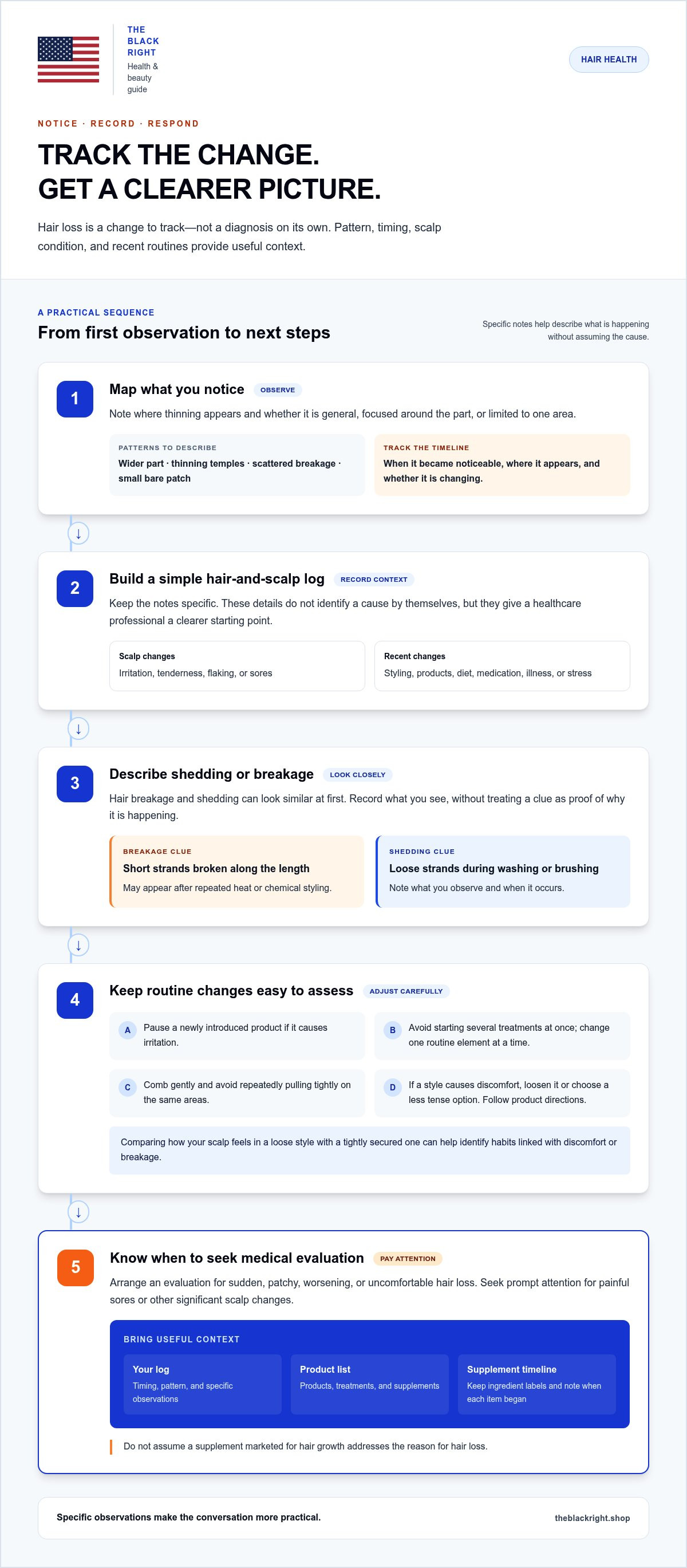
Hair loss is a change to track, not a diagnosis on its own. The pattern, timing, scalp condition, and recent routine all provide useful context. A wider part, thinning temples, scattered breakage, and a small bare patch are different observations. Recording what you notice can help you describe the change clearly.
Start a simple hair-and-scalp log. Note when shedding or thinning became noticeable, where it appears, and whether it is changing. Include recent changes in styling, hair products, diet, medication, illness, or stress. These details don’t identify a cause by themselves, but they give a healthcare professional a clearer starting point and help distinguish a gradual pattern from a sudden change.
- Map the pattern: Record whether thinning is general, focused around the part, or limited to one area.
- Describe the hair: Note whether strands seem to shed from the root or break along the length.
- Track scalp changes: Write down visible irritation, tenderness, flaking, or sores.
- List routine changes: Include tight hairstyles, heat styling, chemical treatments, and new products.
Hair breakage and shedding can look similar at first. Short broken strands, for example, may appear after repeated heat or chemical styling, while loose strands may collect during washing or brushing. These clues describe what’s happening, but don’t prove why. Pause any newly introduced product that causes irritation, and avoid starting several treatments at once. Changing one routine element at a time makes it easier to notice what affects your hair.
Daily handling also affects hair health. Comb gently, avoid repeatedly pulling tightly on the same areas, and follow product directions. If a style causes discomfort, loosen it or choose a less tense option. Compare how your scalp feels in a loose style with how it feels in a tightly secured one. This practical observation can help identify habits that may contribute to discomfort or breakage.
Arrange a medical evaluation for sudden, patchy, worsening, or uncomfortable hair loss. Bring your log and product list, including supplements and treatments. Describe the timing and pattern rather than relying on a broad label such as “thinning.” A clinician can assess your scalp and consider your health history before discussing possible explanations or next steps. Seek prompt attention for painful sores or other significant scalp changes.
Approach supplements as carefully as topical products. Keep the ingredient label and record when you began taking each item. Don’t assume a supplement marketed for hair growth addresses the reason for hair loss. A clear timeline, specific observations, and a consistent routine make hair-health decisions more practical and informed.
How do I choose safe, effective skincare and beauty products?
Start by checking a product’s purpose, ingredients, and directions. A cleanser, moisturizer, and treatment serve different roles, so compare products by function, not packaging. If you want a moisturizer, for example, check that the label identifies it as one and explains how to use it. A promise such as “glow” doesn’t show whether a product fits your routine.
Read the complete ingredient list before buying. Look for ingredients you already know you tolerate, and note any that have caused problems before. If the label lists a specific active ingredient and its concentration, check that information and follow the directions. Don’t combine several new treatments at once. Introducing one product at a time makes it easier to identify which item caused a reaction or changed how your skin feels.
Check the intended area of use. A product made for the face isn’t automatically suitable for the eyes or lips. Mercury compounds may be used in cosmetics only as preservatives in eye-area products, at concentrations not exceeding 65 ppm (0.0065%) of mercury, according to the Centers for Disease Control and Prevention (CDC). Treat this as a specific exception, not a reason to use eye-area products outside their directions.
Introduce a new leave-on product cautiously. Apply it as directed to a small area first, then observe your skin before adding it to your regular routine. Avoid applying several unfamiliar products together, especially if you can’t tell which ingredient triggered discomfort. If irritation occurs, stop using the product and keep its label so you can identify the ingredients later.
- Match the claim to the product: Check whether the label describes a cleanser, moisturizer, or treatment.
- Review ingredients: Compare the list with your known sensitivities and current routine.
- Follow directions: Use the product only on the body area and in the manner stated.
- Keep a record: Note the product name and when you introduced it.
Judge effectiveness against a specific goal, not dramatic marketing language. A cleanser, for example, should be assessed as a cleansing step, not as proof that a separate concern has been resolved. Give your routine a clear purpose, avoid unnecessary overlap, and record changes in a simple product log. If a skin change is persistent, painful, or worsening, prioritize medical advice over adding another cosmetic item.
For a practical browse of related items, explore the health and beauty selection while keeping your ingredient and use checks in mind.
What are the risks of common beauty treatments and supplements?
Beauty treatments and supplements can affect people differently. Risk depends on ingredients, application, frequency, and personal sensitivities. A chemical peel, hair-straightening treatment, and oral supplement each involve different exposures. Review the exact product and process before adding one to your routine. Keep the label or treatment details so you can identify what was used.
Hair straightening products deserve careful label checks. Some products labeled “formaldehyde-free,” “organic” or “natural” tested positive for formaldehyde, according to the New York State Department of Health. A marketing phrase alone doesn’t establish a product’s ingredients. Read the full label, preserve the packaging, and avoid assuming that “natural” means risk-free. If product ingredients or directions are unclear, don’t treat the front label as a substitute.
Topical treatments can overlap, too. Using an exfoliating product alongside another strong-feeling treatment, for example, may make it harder to identify what caused irritation. Start with one new item, follow its directions, and record when you used it. If you notice a reaction, stop adding products and keep the product name and ingredient list for reference. For salon procedures, note the treatment type and products applied, especially when repeating a service.
- Before treatment: Identify the exact product, ingredients, and intended use.
- During a routine change: Introduce one unfamiliar product at a time.
- After a reaction: Stop using the suspected item and keep its label.
- Before repeating a service: Record the treatment and any skin or scalp response.
Review supplements label by label. Compare active ingredients across products, since separate bottles may contain the same ingredient. Check serving directions and don’t take more than the label instructs. Keep a list of supplements alongside medicines and other routine products. This record can help reveal duplication and make it easier to describe what you take if you discuss a health concern with a professional.
Be cautious of claims promising fast changes to your skin, hair, or body shape. A dramatic promise doesn’t explain the ingredients, how to use the product, or which risks apply. Before choosing a treatment, define your goal, read the directions, and consider whether it fits your current routine. If you already use several active skincare products, for example, avoid adding another at the same time. Clear records and one change at a time make reactions easier to trace.
Health wellness
Wellness products often combine ingredient details with broad health promises. Separate what the label says from what it proves. A sea moss product, for example, may highlight its mineral content, while another supplement may focus on a single nutrient. Read the full ingredient list, serving directions, and intended use before comparing options. For health & beauty purchases, a striking claim calls for closer reading, not automatic acceptance.
Sea moss superfoods are described as containing 92 minerals. That figure describes the product claim; it does not, by itself, explain the amount of each mineral in a serving or establish a particular health effect. Check whether the label gives ingredient quantities and serving details. Compare those specifics with the product’s broader claims. If the label emphasizes a total but omits useful serving information, you have less detail for a meaningful comparison.
Genetic wellness claims need similar care. Up to 60% of people carry an MTHFR variant. That figure alone cannot tell an individual what a variant means for their health or whether a supplement is appropriate. Avoid treating a general statistic as a personal result. A genetic test, a supplement label, and a wellness article each provide different kinds of information. Keep those categories separate when weighing a claim.
- Check the exact ingredient: Match the product name to its complete ingredient list.
- Read serving details: Look for quantities and directions, not just headline totals.
- Separate claim from outcome: A listed ingredient or genetic statistic doesn’t establish an individual benefit.
- Record what you use: Keep product names and directions together for easier review.
Make a simple comparison before buying. Write down each product’s intended purpose, featured ingredients, serving information, and directions. Compare two sea moss products by their label details, for example, rather than relying on a larger headline number alone. A clear comparison can reveal formulation differences and make vague promises easier to spot. Keep the packaging so you can identify the exact product.
Before adding a wellness supplement, review your current routine. Check whether existing products already list the same ingredients, then follow each product’s directions. If you have a health condition, take medication, or are considering a product based on genetic information, discuss the specific ingredient and label with a qualified health professional. Bring the package or a clear ingredient list. This gives the discussion a concrete starting point instead of relying on a broad marketing promise.
Use a consistent standard across wellness categories: identify the ingredient, understand the serving, and distinguish product description from personal health conclusions. The 92-mineral sea moss claim and the MTHFR variant figure illustrate why context matters. Neither headline replaces careful label reading or individual medical guidance. For a health & beauty purchase, make the next decision from the details you can actually compare.
Southeastern Health & Wellness Institute in South Carolina is scheduled to host an on-site evaluation visit by peer evaluators in March 2027 as part of its accreditation reaffirmation process. Written comments about its qualifications for accreditation reaffirmation may be mailed to the Commission of the Council on Occupational Education at 7840 Roswell Road, Building 300, Suite 325, Atlanta, Georgia 30350.
Beauty sector
Beauty-sector coverage can show what salons and consumers are discussing. Treat a trend as a prompt for questions, not proof of results. A salon trend headline, for example, may describe a popular service without explaining its ingredients, process, or suitability. Before booking, identify the specific service and ask what it involves. A clear service description makes comparisons more useful.
Health and Beauty Group listed a press release about beauty salon trends dated 15.09.2026. Use a dated item like this as a snapshot, not a permanent rule. Salon offerings and consumer interests can change over time. Compare the date, subject, and details before applying a trend to your own routine. A trend report can inform your research, but it doesn’t replace clear service information.
For salon services, focus on what happens during the appointment. A haircut, hair-color service, facial, and straightening treatment each involve different steps. Request a plain-language description of the process, products used, and aftercare instructions. Write down those details before comparing options. If two services have similar names, compare their actual steps rather than relying on the labels.
- Define your goal: Choose a specific result, such as a trim or color change.
- Compare the process: Note products, application steps, and aftercare guidance.
- Check the timing: Use publication dates to understand when a trend appeared.
- Separate claims from details: A popular label doesn’t describe the service itself.
Product and salon trends also influence how shoppers assess claims. A phrase such as “salon-inspired” may describe how a product is positioned, but it doesn’t explain how to use it. Look for the intended purpose, ingredient information, directions, and relevant limitations. Compare a leave-in product with a rinse-out treatment, for example, by reading the instructions on each label. This gives you practical information beyond promotional wording.
Make a short comparison before choosing a service or product. Record its name, stated purpose, process or directions, and any aftercare information. Keep salon consultation notes alongside product labels. If a recommendation involves a new treatment, ask how it fits your existing routine. Specific questions clarify your options without relying on trend language or broad promises.
Use beauty-sector coverage as a starting point for informed decisions. Check the publication date, identify the service or product discussed, and compare its details with your needs. Then choose your next salon visit or beauty purchase using clear, practical criteria.
The Black Right: 60W Wireless Charger Pad for iPhone & Samsung Phones
The Black Right offers a 60W Wireless Charger Pad for iPhone & Samsung Phones, a practical phone-charging accessory rather than a skincare or hair treatment. Consider it if you want a wireless charging option for a compatible iPhone or Samsung phone. Keep product choices separate: a charger supports everyday device use, while skin and hair concerns call for relevant care and informed product decisions.
For a health and beauty routine, focus on products that match your specific needs, and read their labels and directions. Choose a charger for its stated purpose, not as a wellness product or beauty solution. That distinction keeps expectations clear and helps you select the right item for the job.
Visit theblackright.shop to explore The Black Right’s offerings.
Make Your Next Choice With Care
Let your next health & beauty decision start with a clear personal priority, not a trend or dramatic promise. Decide what you want to address and what information matters for that choice, then keep your routine manageable. A simple rule can help: understand the product’s purpose, read its directions, and avoid adding several unfamiliar items at once.
For changes that affect your wellbeing, treat product selection as one part of a wider care plan. Keep notes on what you use and how your routine changes, so future decisions have useful context. Choose practical additions that suit your everyday needs, and leave out items that don’t fit your goal.
Explore The Black Right’s available products and find practical options for your needs. Browse the available selection, then move forward with a choice that feels clear and considered.

